
Why Isn’t There Grass Fed Pork?
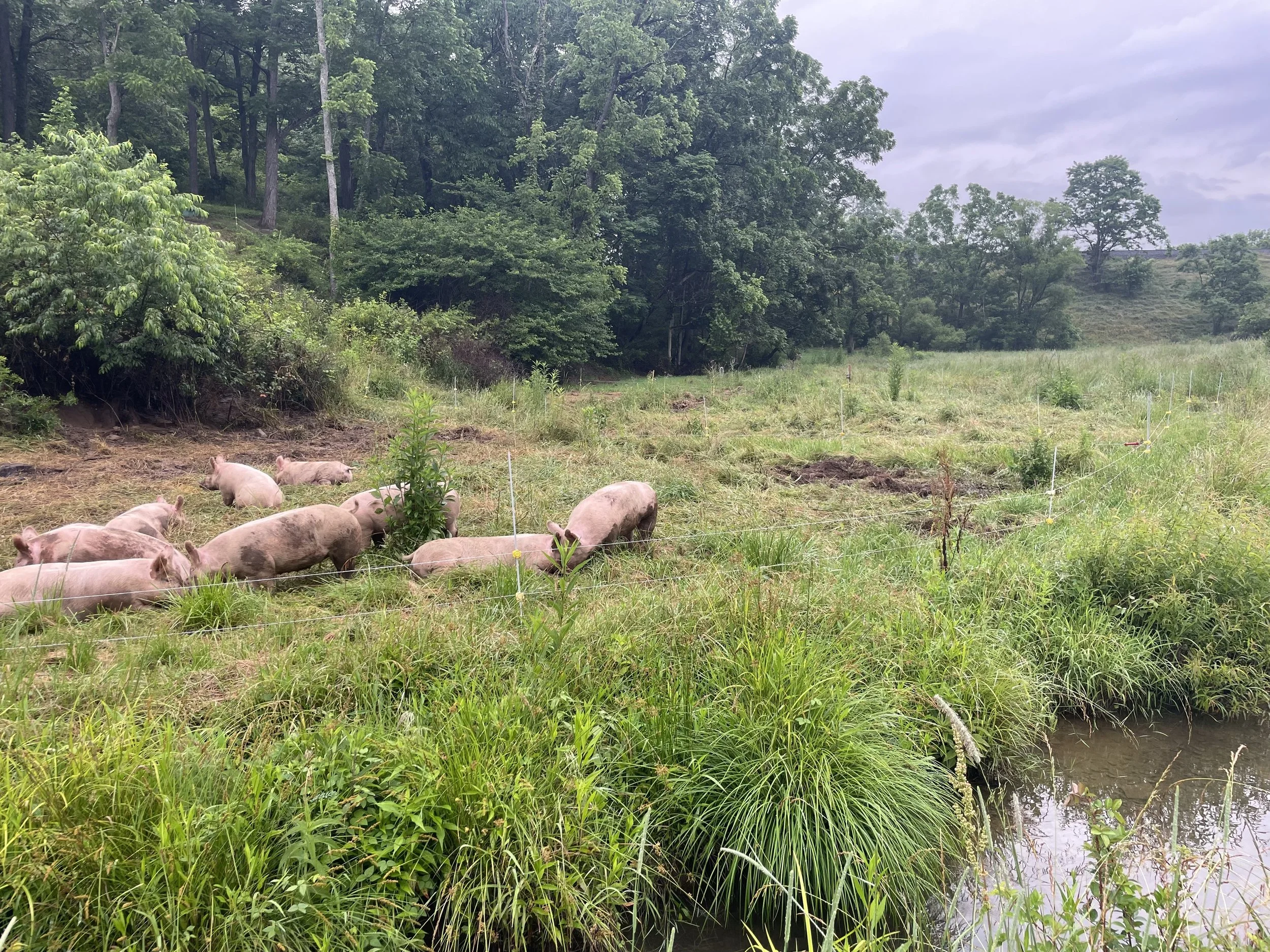
The pigs enjoying pasture on a gloomy day in the valley.
You’ve seen the many buzzword labels in the grocery store that try to appeal to the caring consumer that you are.
Pasture raised.
Grass fed.
Grass finished.
Free range.
Cruelty-free.
We use the term “pasture raised” constantly to describe our pork. But, why don’t we describe them as grass fed? And, why does grass fed pork seem to be missing from the shelves of the grocery stores?
The answer lies in the digestive anatomy of pigs! Which happens to be more similar to humans than their farm counterparts, the cows.
An explanation of the term “pasture raised.”
On our farm, the term “pasture raised” refers to the fact that our pork lives outdoors, exploring pasture and forest, rooting, digging, and eating fresh vegetation and other grub to their liking. They are happier and healthier as a result, enjoying life as a pig was meant to live. We rotate our pigs to new, fresh ground roughly once a week. Our pigs also have 24-hour access to supplemental grain, which is why we never claim to be raising “100% grass fed” pork.
In general, when used honestly, “pasture raised” should refer to animals that spend the large majority of their life outdoors on fresh ground and eat a supplemental diet of grain.
Why can the cows be 100% grass fed?
Cows are called ruminants. This essentially describes the fact that they have a complex digestive system capable of breaking down cellulose in a way that makes it usable for energy. Cellulose is a tough and sturdy carbohydrate molecule that makes up the cell walls of plants. Due to the shape of bonds that hold a cellulose molecule together, it’s a hard molecule to digest.
So hard, in fact, that humans and pigs (and a list of other organisms) cannot break it down in their digestive tracts, and therefore, cannot use it for energy.
A closer look at the cow’s digestive system
Cows have a complicated digestive system that’s truly amazing. It includes a four chambered stomach that’s specifically designed to allow them to turn grass into energy without needing to supplement their diet with grains or other foods. One of these four chambers, the rumen, is the star of the show when it comes to breaking down cellulose.
Within the rumen, specialized microorganisms, primarily bacteria, live and ferment vegetation that the cow has ingested. “Ferment” literally just means using bacteria (in this case) to break down a substance. While breaking down grass, the microbes turn it into available energy for the cows. Typically, a healthy cow will also spend a large portion of its day regurgitating and re-chewing ingested grass, a process called rumination or “chewing the cud,” which simply makes the digestion process a bit easier for the rumen microorganisms.
Now for the pigs & humans.
Pigs’ digestive systems are simpler than those of cows. Like us, pigs have a monogastric digestive system, which means they have one stomach. Thus, there is no specialized rumen capable of fermenting grass and breaking down cellulose for energy. Therefore, pigs (and humans!) need other types of food to provide them with energy. That’s why pigs are omnivores, like us! A pasture raised pig’s diet can be happily and healthily supplemented with grain for that reason.
Pigs are capable of a diverse omnivorous diet, and when allowed to root and forage for food on their own, they will eat insects, nuts, roots, eggs, and other non-grass foods in the wild. So, it is technically possible for pigs to survive without grain.
However, it would take a huge amount of area for the pigs to obtain the nutrition needed to maintain a healthy diet, and the farmland wouldn’t necessarily be better off in the long run with that management style. To use pigs’ God-given shovelling nose and rooting behaviors as a beneficial, net positive land management tool, rotating them through small areas quickly is the best way to manage pigs on a farm. Feeding pigs grain allows farmers to do this while maintaining a healthy diet and growth trajectory for the pigs.
The more you know!
Hannah