
Why Biodiversity Wins on A Farm
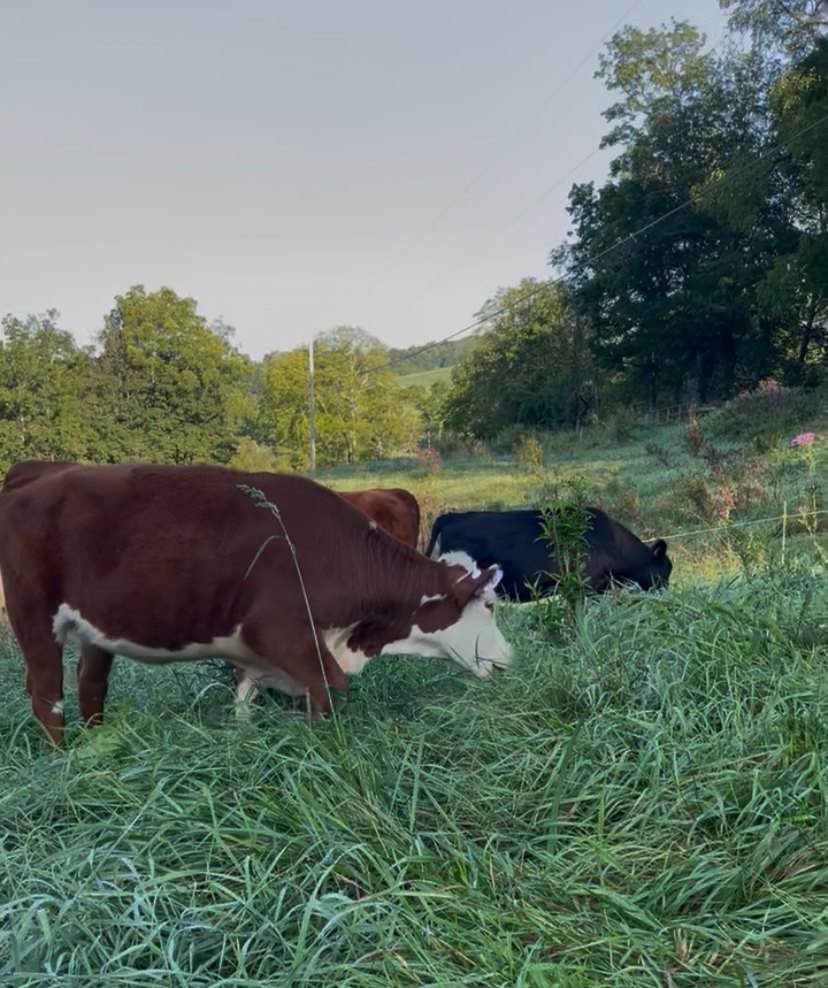
Hereford and Angus cattle, sharing pasture.
Conventional, industrial agriculture practices probably conjure up some familiar images in your mind:
Rows upon rows of corn as far as you can see.
Neat rows of tobacco plants repeated down a field so neatly it seems like an optical illusion.
Fields dotted with Black Angus cattle, heads down, munching on pasture.
Each the epitome of a monoculture - when one breed or species is concentrated in an environment.
Now, imagine looking out over a wild landscape that’s untouched by humans.
You see hundreds, if not thousands, of different plants, with just as many insects buzzing and jumping around them. Multiple different types of birds are soaring through the sky, coexisting with each other. Maybe as you scan the landscape you see foxes, deer, squirrels, mice, rabbits, and more, thriving in their own specific role within the ecosystem. And the soil beneath these organisms is teeming with infinite life.
This scene is dramatically different from the modern day industrial agriculture monocultures we have grown accustomed to.
This scene is also much more resilient than that of the industrial monocultures.
The coexistence of a multitude of different species in the same environment is referred to as biodiversity.
Biodiversity is the norm in nature. Biodiversity results in resilience in an ecosystem.
And, as famed pioneering regenerative farmer Will Harris of White Oak Pastures says, “Nature abhors a monoculture.”
So, why do we think of farms as being built in a manner that is opposite of what nature intended?
How Biodiversity Builds a Resilient Farm
Imagine a room full of people that all have the same allergy - let’s say peanuts. We give each of them a peanut to eat, and they all go into anaphylactic shock.
The entire room is vulnerable to succumbing to the same illness.
A frantic medical response ensues, with some patients having a long wait, a long illness, and therefore, a worse overall recovery.
This represents the nearly non-existent resilience of monoculture farm operations.
All of the members of the single species or breed that are concentrated on the farm all have the same weakness, so the farm can lose its entire crop or herd to one illness very easily.
Now, imagine a room full of a variety of people that don’t all have the same peanut allergy.
The peanut now does way less damage.
Those that do have the peanut allergy can get higher quality, faster attention to their anaphylaxis, resulting in a faster recovery and less severe illness.
Overall, the room of people is happier, healthier, and stronger as a result of their diversity.
The same is true in agriculture. When we plan our farms or homesteads for biodiversity and resilience as opposed to quantity and pure efficiency, we plan for a more successful, nutritious, and happier farm.
This means better food for your family.
Farming in alignment with nature looks differently than most modern day farms: cows and pigs of many colors, no-till gardens, crop rotations, inter-crop planting, rotational grazing.
These practices are a stark contrast to the endless rows of corn grown year after year on the same plot of land that we often envision when we think of “farm land.”
The benefits of a biodiverse, regenerative farm are plentiful.
On our farm, we are not breed-specific. We are performance-specific.
For example, when it comes to beef, our goal is to use the beneficial features of multiple breeds of cattle to result in a herd that is resilient, diverse, and produces high quality, nutritious, pasture-raised beef.
More resilient plants. More resilient animals. More nutritious food.
The earth and its animals can and will work for you and not against you. Nature will feed into the farm naturally and help it be successful.
We just need to take the time to listen to, and learn from, nature.
-Hannah